
You receive three quotes for a stand, all wildly different, and your management expects a justified decision by the end of the week. The budget is tight, the ROI will have to be defended, and no one on your team is really an expert in how a stand is built. A familiar situation for a communications, marketing or events manager at a B2B SME or mid-market company. This article gives you concrete reference points to decide: what an exhibition stand really is, the types that exist, and what each one changes for your budget and your sales leads. You’ll see why reusable equipment, adaptable from one show to the next, weighs differently over three years, a logic that WonderStand, a French manufacturer of modular and custom stands made in Europe, has applied for more than ten years alongside exhibitors.
Exhibition stand: definition and function for a B2B exhibitor
What is an exhibition stand?
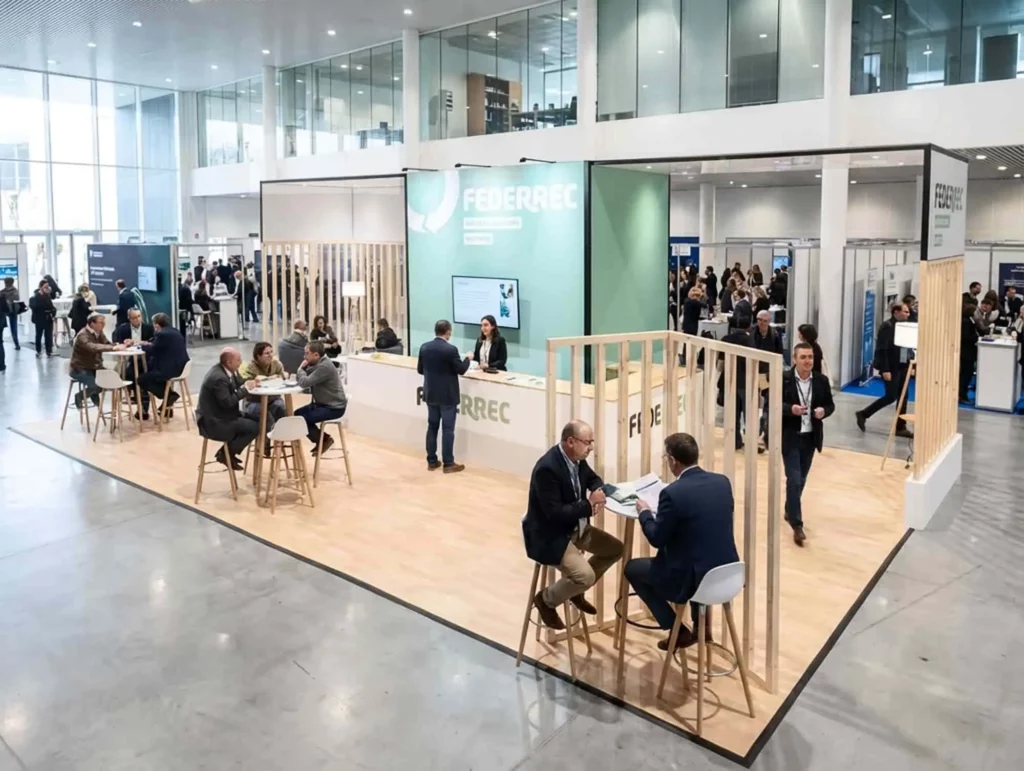
An exhibition stand is a temporary, fitted-out space set up at a trade show, fair or convention that lets a company present its products or services and meet qualified visitors. It’s your physical showcase for the length of an event, on floor space you rent from the exhibition venue.
A stand always combines the same ingredients: a structure, a space layout, signage, furniture and your communication materials. For an SME or a mid-market company, the surface most often runs between 12 and 40 m². And the market is far from marginal: France hosts around 750 trade shows, 6.6 million visits and 113,600 exhibitors every year (Promosalons, via the UNIMEV Observatory, 2026).
Keep this in mind: a stand is not a piece of furniture you set up and then forget. It’s a commercial workspace, meant to last a few days but prepared over several weeks. The way you design it determines what your teams will get out of it on the day.
Why is a stand a communication tool before it’s a decoration?
An exhibition stand is first and foremost a communication tool: it extends your brand image into physical space and serves to attract, filter and then convert visitors into sales contacts. Looks matter, but they aren’t the point.
At a trade show, dozens of exhibitors compete for the same attention, at the same time, in the same aisles. So your stand has to do three things: get noticed from a distance, make people want to stop, and make conversation easy once the visitor is in front of you. A decoration ticks the first box. A communication tool ticks all three.
Picture a scene you know well. Your salespeople come back from a show. The question your management asks isn’t “did the stand look nice?”, but “how many useful contacts did you bring back?”. A stand designed as a visual communication medium answers that question: it directs the eye toward your offer, carries your message without a word, and puts your teams in a position to talk to the right people. That’s the difference between a decorated surface and a commercial setup.
What’s the difference between a stand, a stall and an exhibition space?
The difference comes down to the level of design and commercial intent: a stall shows goods in a basic way, a stand is a designed space that carries a brand identity, and “exhibition space” is the umbrella term covering both.
Here are the three notions, one line each:
- The stall: a simple product display, in a fair or market logic, with no brand staging.
- The stand: a fitted-out, personalised space that carries your visual identity, designed to attract and engage professional visitors.
- The exhibition space: the general term covering any temporary surface dedicated to presenting a company at a show.
For a B2B decision-maker, this distinction is more than vocabulary. Choosing a real stand over a simple stall means deciding that your presence carries a message, not just products laid out on a table. It’s also what separates a show that pays off from one you merely endure. Which raises the question every marketing manager asks once the definition is clear: what types of stands exist, and which one fits your situation?
What are the different types of exhibition stands?
Pop-up, modular or custom stand: what are the differences?
There are three main families of exhibition stands: the pop-up stand (light and portable), the modular stand (reusable and adaptable to different surfaces) and the custom stand (designed to match the brand). Each targets a different need and budget.
The word “modular” deserves a simple translation. Picture a set of industrial building blocks you reconfigure from one show to the next: the same elements make up a 12 m² stand at a regional show, then a 40 m² stand at an international event, with the same visual identity in both cases. You don’t start from scratch every time.
| Stand type | How it works | Reusable | Exhibitor profile |
|---|---|---|---|
| Pop-up stand | Light, portable structure, set up tool-free in minutes | Yes, for simple use | First-time exhibitor, one-off presence, tight budget |
| Modular stand | Blocks reconfigurable from one surface to another, visual identity kept | Yes, over several years | Company doing 3 or 4 shows a year, controlled budget |
| Custom stand | Design specific to your brand, high-end volumes and finishes | Depending on the design | Maximum differentiation at a flagship show |
WonderStand covers these families with modular and custom equipment made in Europe, some elements of which set up tool-free and last several years.
Should you rent or buy your exhibition stand?
Renting suits first-time exhibitors and one-off appearances, while buying pays off from two to three shows a year. The tipping point depends on your calendar, not on a general rule.
Stand rental has a clear advantage: no storage, no maintenance, equipment delivered and taken back. You test a show without tying up budget. Buying, on the other hand, changes the logic as soon as you exhibit regularly, because the cost spreads across each edition. Watch out, though, for the expenses first-time exhibitors forget:
- storing the stand between shows;
- regularly refreshing the graphics to stay current;
- transport and assembly, often underestimated in a first quote.
Between the two, the all-in-one option deserves the attention of a team with no dedicated logistics: the equipment arrives ready to use, delivered assembled, and you keep control of your presence without tying up internal resources.
Which type of stand for which exhibitor profile?
The right type of stand depends on how often you exhibit, how much your surfaces vary, and the level of differentiation you’re after. Here’s a reading grid you can act on directly:
- You’re testing a show or just starting out: go for rental or a pop-up stand, without committing a heavy budget.
- You exhibit at 3 or 4 shows a year: a reusable modular stand amortises its cost and keeps a consistent image from one event to the next.
- You’re playing for differentiation at a major show: custom gives volume and finishes to your image, where visibility matters most.
WonderStand offers exactly these formats: rental for occasional exhibitors, modular for regulars, custom for flagship moments, plus all-in-one kits. This range avoids a common trap: paying for a custom stand when an adaptable modular one would have done, or the reverse. Once the format is set, one question calls for a numbers answer: what will this stand actually bring your company?
What an exhibition stand really changes for your presence at a show
How does a stand influence B2B lead generation?
The return on an exhibition stand isn’t measured by its looks, but by the qualified contacts generated and the deals signed in the months after the show. A beautiful stand that brings no one in is worth nothing to your pipeline.
The space layout directly affects three parameters: visitor flow, the time they spend with you, and the quality of the exchanges. The stands that convert best are designed as a journey, not a static showcase:
- an open welcome zone, that invites people in rather than past;
- a demo space, where your products or services are shown in action;
- a quieter conversation corner, to open a sales discussion in calm.
On the day, this logic makes the difference for your salespeople. A visitor naturally guided toward your offer stays longer, and a visitor who stays becomes a workable contact. It’s that direct customer contact, once qualified, that your management expects in return for the investment.
Why is the real cost of a stand calculated across several shows?
The real cost of a stand is calculated across several shows, not at the moment of purchase: a reusable stand amortised over three to five events costs less per show than a disposable stand renewed every year. That’s the reasoning that changes everything in a budget trade-off.
Put the question differently in front of your management. Not “how much does this stand cost?”, but “how much does this stand cost per show, over three years?”. Modular equipment that adapts to different surfaces, sets up tool-free and lasts several years dilutes its bill with each edition. A decor renewed every year, by contrast, starts from scratch each time. That’s WonderStand’s positioning, a French manufacturer of reusable stands made in Europe.
This logic meets a rising expectation: environmental responsibility. In France, professional events account for around 1% of national greenhouse gas emissions, and stands are among the top waste items at a show (ADEME, 2023). More and more clients and organisers are asking for measurable commitments. A stand built to last then becomes an argument in a call for tenders, where a disposable stand works against you.
What questions should you ask before approving your stand project?
Before approving your project, ask yourself a few concrete questions that will determine the format and budget suited to your show calendar. This list will also help you calmly compare two or three quotes.
- How many shows do you attend per year, and on what varying surfaces?
- Rent or buy: does your frequency justify tying up a budget?
- Does the manufacturer handle transport, assembly and storage between editions?
- Is the equipment reusable and reconfigurable, from a 12 m² show to a 40 m² stand?
- Have you planned to measure the contacts and leads generated, to defend the budget next year?
These answers are worth more than a long technical brief. They put you in a position to decide, not to endure a supplier’s proposal. That’s also WonderStand’s turf, where Maxime Wilson, with 12 years in the trade, has supported more than 200 companies at shows such as Big Data Paris, Eurosatory and Maison & Objet. Preparing a flagship moment and aiming for differentiation? Discover our range of custom stands made in Europe.
The exhibition stand, an investment to think across several shows
Keep three ideas in mind. An exhibition stand is first a communication tool that has to bring back contacts, not just decorate a surface. The right format depends on your calendar: rental to test, modular for regulars, custom for flagship moments. And its real cost reads per show, over several years, not at the moment of purchase.
The market confirms this reading. In 2026, trade shows are holding up better than consumer events, and organisers and clients alike are building more environmental rules into their specifications. Reusable is becoming a tender advantage, not a constraint, and the B2B exhibitor matures as they start to think in terms of an annual programme rather than isolated events.
From there, it’s better to think like a long-term partner than a one-off supplier. That’s WonderStand’s way of working: designing equipment that follows you from one show to the next, year after year, with field expertise at your side.
